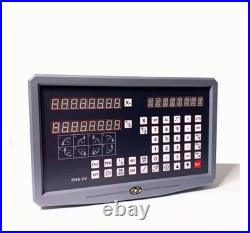

Milling Machine Linear Scale Digital Readout. Lathe Grinder High-Precision Displacement Sensor. Machine Tool Electronic Scale. Communication Method: TTL Single-Wave Incremental. Digital Readout Scale: Scale 5V/Digital Readout 80-220V. Applicable Equipment: Milling machines, lathes, grinders, wire cutting machines, machining centers. Single-scale dual-axis system: Approx. Dual-scale dual-axis system: Approx. Triple-scale tri-axis system: Approx. Q: What is the minimum customizable travel length for a linear encoder? Due to readhead limitations, the shortest travel currently supported is 50mm. Can the grating scale transmit data directly to a computer? A: Direct connection is not possible, but data can be transmitted via the 232 protocol. A digital readout with 232 capability can transmit grating scale data to other 232-compatible devices, such as computers. Can the grating scale be zeroed? Does it require recalibration after power loss? Answer: The linear encoder can be set to zero but lacks limit indicators. After power loss, it remains stationary at its last position. Upon power-up, it can return to zero or continue forward without requiring recalibration. However, if moved after power loss, recalibration is needed upon power-up. Question: Can the linear encoder be manually driven? The encoder itself cannot move and requires an external drive mechanism, including manual operation. Question: What is the output pulse count of the linear encoder? Answer: Output pulses = Resolution (mm) × 4. For a 5? M encoder: 50 pulses/mm = 50 × 4 = 200 pulses/mm. Note: Pulse loss occurs when exceeding 60 pulses/mm. What is the output frequency of the linear encoder? A: Output frequency depends on movement speed and resolution. Frequency = Movement Speed / (Resolution 4). For example, with a 5? M resolution scale moving at 1m/s: Frequency = 1000 / (0.005 4) = 50000Hz (50kHz). Q: Can the linear encoder communicate with a PLC? A: The linear encoder cannot directly communicate with a PLC, but PLC software can be programmed to acquire data from the encoder. Q: What is the difference between an LCD display and an LED display? A: An LCD display uses liquid crystal technology, while an LED display employs digital tubes. LCD screens consume less power and are more energy-efficient, but they have higher manufacturing costs.